The 1911-A1 pistol and the .45ACP cartridge; the story of America's bigger better bullets. . .
If you happen to be a gun dork what follows is likely a story that you've heard, read, re-read, and told countless times. Still, I think it's an interesting bit of history. What's more, over the years I've noticed that you can learn a lot about the character and sensibilities of different nations by looking at the weapons their militaries adopt. So, maybe there's some help in character development in here somewhere. . .
Imagine this: you're an American soldier in the Philipines and the year is 1905. Your weapons, equipment, and training are the best in the world, and you happen to be fighting these guys:
they're guerillas (Moro warriors) fighting for Philipine independence. Take another look at that picture. Notice anything? Oh right, they don't have guns. Yes, you are an American soldier with the best military equipment in the world, and you're fighting a bunch of guys that quite often are armed with only spears, knives, and a crap-ton of spite. Feeling pretty cocky, ey? Well, my over-confident West Point educated friend, you're in for a surprise.
You see, the moro warriors had two secret weapons; rage and drugs. Rage does peculiar things to a person, not the least of which is it amps up their adrenaline and lessens their pain response. Add a healthy dose of narcotics and you've got all the makings of a berserker rage of epic proportions. Historical accounts abound with stories of really high, really angry, and really gunless moro warriors attacking American positions getting shot six or seven tims and killing a bunch of people,
before they eventually dropped dead. That's quite a pickle of a situation, if I do say so myself.
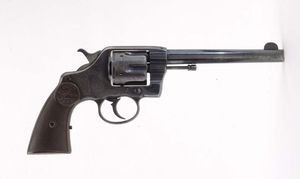
So let's pick apart the situation. If you're an officer watching the horror unfold, you're likely armed with a .38 Colt M1892 revolver just like the one you see here:
 Despite (or perhaps in spite) of the fact that it's a cool looking modern gun, it's also chambered in one of the most anemic and underpowered cartridges ever; the .38 Long Colt cartridge. The bullet in question leaves the muzzle traveling at 770 feet per second, measures .35" at its widest point, and weighs in at 150 grains. If you're not a gun dork, those specificiations are probably meaningless.
So let's put this in perspective. When the Army called in its engineers they responded with the 1911A1; an even cooler even more modern looking pistol design which was chambered in the new .45ACP caliber. The bullet leaves the muzzle at between 850-900 feet per second (a full 100 feet faster and just shy of the speed of sound) weighs in at 230 grains (a full 80 grains heavier or 65% heavier) and measuring .45" at its widest point (for a gain of .1" in width or more than a 10% increase). In other words, the Army went from being armed with pistols that shot out a pea to pistols that--for all intents and purposes--drove a metaphorical bowling ball towards the enemy at near supersonic speeds.
The new gun was named the 1911A1 pistol and looked a little something like this:
 Designed by John Moses Browning the 1911A1 was the standard sidearm of the American military forces between 1905 and 1989, and still remains the top choice of elite tactical units the world over (the FBI SWAT team still arms its members with 1911 pistols). What's more, for the almost century long career of the 1911A1 pistol, the American forces had the biggest most powerful pistol of any other nation. Aside from bigger bullets, the 1911 design allowed officers to reload their guns more quickly than ever before, carry an extra 2 rounds than before, and (perhaps most importantly) look way cooler than their allies or enemies.
What happened in 1989? America's allies in NATO grew tired of not being able to have compatible ammunition with them, because American guns were way bigger. So, in 1989 the United States officially retired the M1911A1 pistol in favor of the 9mm Beretta M9. Which incidentally, decreased the bullet size to the same .35" that had prompted the adoption of the .45. Now, a few years after switching to the 9mm (.35 caliber), many elite units of the Marines are dusting off their old stores of 1911's, mostly because they're tired of getting overrun and killed by poorly armed enemy combatants (sound familiar?).
So, what's the lesson to be learned from all this? There are probably a few. First, never ever ever underestimate your enemy. Second, when in doubt grab the biggest gun you can. Third, American philosophy towards armament had a historical bigger is better philosophy.
Excelsior!
Epilogue
Watch 1998's film: Ronin starring Robert De Niro, and you'll notice he's carrying a 1911. In the opening moments of the film his character gets into a discussion with a weapons expert/dealer about what his choice of sidearm is. His answer? After being told the virtues of the most modern 9mm pistol; "[sic]a 1911, because it works."