Monday, April 11, 2011

Martial Arts/Movie Monday: "Are Martial Arts Ruining Action Movies?"

I recently read the editorial below that appeared in the New York Times Magazine. The comments are not really new, and share several points in common with the post I made about "wire-fu" a little while back. Namely, that the explosion of Hong Kong style fight choreography in Hollywood action films has resulted in all fight scenes now looking the same, with the same balletic kung-fu inspired choreography.

I don't agree with everything the writer argues (And the almost complete absence of including anything outside of Hollywood is a serious omission, given the international nature of film today). But as much as I enjoy the Hong Kong style of combat, it does have it's time and place, and perhaps has oversaturated the market in some bad ways. I really didn't care for Brad Pitt's leaping style of swordfighting in Troy (2004) and was very surprised that the ancient Egyptians apparently practiced Chinese style kung-fu in The Mummy Returns (2001). I only recently saw Wanted (2008) and frankly, the less I see of that sort of CGI-enhanced stuntwork the better.

In any case, as a movie watcher, I'm not too concerned about the reliance on overly-choreographed fight sequences. Trends always go in cycles, and there's already been several good movies that incorporate the messier, less stylized work of earlier film makers (Inception (2010) and the recent Bond films come to mind).

Anyway, check out this great chaotic brawl from Martin Scorsese's 1973 breakthrough film Mean Streets: http://www.youtube.com/watch?v=Tx6fbGBYi84


http://nymag.com/daily/entertainment/2011/04/are_martial_arts_ruining_action.html

Are Martial Arts Ruining Action Movies?

Are Martial Arts Ruining Action Movies?

Photo: Columbia Pictures, Paramount Pictures, Focus Features, Warner Bros. Pictures, Columbia Pictures, iStockphoto

In Joe Wright's stylish action-drama Hanna, the titular character (played by Saoirse Ronan) has been raised by her father to study martial arts and close combat in seclusion before finally entering the real world at age 16, ready to kick some ass. She's never met a person other than her father (Eric Bana), she's never set foot anywhere other than the wintry landscapes of North Finland, and she's never known pop culture or seen a single movie ... and it's a good thing she hasn't, because if Hanna were to duck into a theater to catch the latest action flick, she'd be stunned: Everybody fights like her in movies nowadays. And it's starting to take the fun out of things.

Actors often brag about how much Krav Maga or karate or capoeira they had to learn for their roles, but to judge from the onscreen world of modern action movies, that kind of skill set is hardly rare: A built-in understanding of martial arts is instilled in everyone, be they hero, villain, or mere henchman. (Fortunately, heroes always get to fight off bad guys who somehow know the exact same form of martial arts they do.) Too often, it seems like movies grind to a halt for obligatory hand-to-hand combat with low stakes and little invention, as though the screenwriter typed, "A fight breaks out," and the director left it up to the second unit and fight coordinator to fill three minutes.

It was fun when the trend began — when The Matrix westernized the modern martial arts movie and the Drew Barrymore–led Charlie's Angels traded guns for roundhouse kicks — but it has quickly become rote. In movies like The Green Hornet, Salt, Sucker Punch, and The Last Airbender, the heroes fight off drone after drone after drone, occasionally taking a hit to the face, stomach, or back, yet emerging with little more than a comely cut on the cheek (if that). With little in the way of stakes, a sameness in presentation, and no blood or bruises, martial arts have turned action scenes into dance scenes, and while those can be fun, they're not usually renowned for their suspense. Scott Pilgrim vs. the World was occasionally inventive within its fight sequences, but it was really more of a musical, and even Wright himself has admitted that when choreographing Hanna's fights, he figured, "Just treat it like dance and it'll be fine." That's all well and good, but whatever happened to treating action sequences like action sequences?

Gone are the days when a fight might involve a gun, a makeshift weapon, or a hit that actually hurts. Now every movie hero is Jet Li, and every woman is Buffy the Vampire Slayer (though Buffy's martial-arts acumen was a by-product of her mystical Slayer power, the new breed of action heroine can dispatch a 200-pound assailant even if the woman in question is five-foot-two and has a physique better suited for red carpets than battle). Hanna handles its action scenes better than most — and Bana gets a fun all-in-one-take fight that's highly choreographed but is at least dazzling to watch — but even the most stylish spin on these sort of fights can't disguise the feeling that we've seen this all before. It's time for directors to rethink the idea of a movie fight sequence, and if they can't add anything to it — or if watching the hero toss another drone over his shoulder adds nothing to the movie — then it should go. After all, what does it say when an actual dance movie, Black Swan, has ballet sequences and cathartic confrontations that pack more punch than any action movie we've seen over the past year?

Monday, April 4, 2011

Martial Arts/Movie Monday: The Challenge (1982)

Here's a largely forgotten movie from the early 80s that occasionally pops up in the late-night slot on the tube (during that same godforsaken hour reserved for "Bloodsport"): "The Challenge" (1982).

This semi-B-grade American action film boasts a rather impressive pedigree given the final product. The director is John Frankenheimer, who among other things directed the bona fide Cold War classic "The Manchurian Candidate" (1962) and decades later did one of the definitive post-Cold War thrillers "Ronin" (1998). The star of the movie is Scott Glenn, who is probably best known for playing astronaut Alan Shepherd in "The Right Stuff" (1983) and Jodie Foster's boss in "Silence of the Lambs" (1991). Supporting Glenn is the legendary Toshiro Mifune, star of countless classic Japanese samurai films including "The Seven Samurai"(1954).

Glenn plays a down-on-his-luck boxer who is hired by some mysterious Japanese visitors to escort an ancient sword to Japan from the U.S. What he doesn't know is that the sword is part of a revered pair known as "The Equals" which belong to the mysterious family the Yoshidas.

The Yoshidas live an almost monastic existence on an opulent family estate, where they maintain the ancient traditions of the samurai and continue to practice the traditional fighting arts. Unfortunately, the family has been divided by a quarrel between the brothers Toru (Mifune) and Hideo (Atsuo Nakamura). Part of that quarrel has been over the Equals, which have been separated since World War II and both brothers are desperate to lay claim upon.

Glenn finds himself drawn into this archaic family intrigue, but also becomes fascinated by the martial traditions upheld by Toru. After being beaten between in an ill-advised match with Yoshida's top student and suffering various others humiliations, Glenn elects to become a student of the family. Quickly he gains mastery of the sword, staff, spear and other ancient techniques. Good thing too, because the family quarrel is about to burst into an all-out war, with brother Hideo (now a powerful CEO of a high-tech company) ready to bring in the guns and thugs.

The plot of "The Challenge" is nothing to shout about. It's a fairly standard revenge and honor plot, common to both Eastern martial arts films and their American counterparts (though surprisingly, there's no slain master or father figure to avenge). It also features the tiresome cliche of the white guy traveling to a foreign land to master exotic fighting arts within a short amount of time, as well as romance one of the local babes (a.k.a. the plot of "Dances with Wolves," "The Last Samurai," "Avatar," etc. etc.). That being said, the film was made before that trope had become so overdone.

What stands out about "The Challenge" though are the hand-to-hand action scenes. Whereas a lot of Hollywood films popularly incorporate Hong Kong kung-fu style action, "The Challenge" is one of the few to feature genuinely Japanese martial arts. There are chambara style sword fights with katana, good use of archery, plus various dirks, daggers and throwing stars. There's also a very impressive use of Aikido-based fighting.

Check out this clip where Scott Glenn gets a harsh lesson (Sorry, only a German dubbed clip was available): http://www.youtube.com/watch?v=JEL08kvdNEY

Guess the fighting scenes shouldn't be that much of a surprise. Scroll through the credits and you will find a familiar-sounding name listed as choreographer: Steven Seagal.

Friday, April 1, 2011

Think Tank Thursday: Reality's Fine Line

How do you determine what is real and what is not?

When you first look at this question you may think it is absurdly simple. Really think, however, about how you decide what is real. Hallucinations can involve the sensations of touch, taste, sound and sight, so those are not as reliable as we would like to believe.

In the end what is real is determined because we eventually say it is so. In order to not go crazy or waste resources, our minds categorize things we see often and trust that similar things will also be real.

Everything we experience is processed in the mind, real or imaginary. The fine line lies in our categorization of the information.

Theatrically we  use this to our advantage, often without knowing it. We are told as actors to root our experiences in a basis of reality. This allows the audience to automatically assume that the performance is realistic. Because the audience knows they are at a performance, and in our current culture all performances of plays are high level pretending, they will have a basic line between reap and fake from the start. Once you root them to your performance with realistic elements, you entrap them and allow for more fantastic elements to be slipped in with less resistance.

Although we base our reality on what we have seen or experienced before, in order to progress our knowledge our minds have to remain open to the idea that new experiences can be just as real as old. Basically, the audience is ready to believe what ever you tell them. Getting their trust in the very beginning is crucial, it will allow for more of the play to be accepted. If you don't get the audience hooked in the beginning it isn't the end, they are watching for enjoyment, they will check in again and again to try and gain a foothold. The audience can't enjoy what it doesn't understand and the mind can't stand uncertainty, it causes anxiety and frustration (plus no one likes to think they wasted money).

Suspension of disbelief is vital and the audience is ready to give it, they just need to trust where they will be taken when they do.

Greg Poljacik

Monday, March 28, 2011

Movie/Martial Arts Monday: Remake, Redone, Redeux

I was recently perusing the movie news and it looks like there's a couple of notable remakes of classic combat-themed dramas coming our way.

First off is the latest version of Alexander Dumas' The Three Musketeers. This time, director Paul W.S. Anderson (helmer of the Resident Evil film series) is calling the shots for Musketeers Athos (Matthew Macfadyen), Porthos (Ray Stevenson) and Aramis (Luke Evans), along with Musketter wannabe D'Artagnan (Logan Lerman). The film isn't due until October, but a trailer recently was released online and before certain films.

Trailer for The Three Musketeers (2011): http://www.youtube.com/watch?v=uvHqXkUZaS4

I didn't read the actual novel until about six years ago, and was quite surprised by the complexity of the plot with its multiple characters, backstories, intrigue and conspiracies. I was also quite surprised how bawdy it all was. Like many, I had always assumed that the tale of the Musketeers was a simple tale of escapism.

There have been, of course, many, many, many film versions of The Three Musketeers. Almost too many to count. However, my personal recommendation is definitely the critics' favorite, director Richard Lester's two-film opus The Three Musketeers (1973) and The Four Musketeers (1974). Lester and his producers the Salkind Brothers (who later made the Christopher Reeve Superman films) essentially split Dumas' massive novel into two feature-length films, which allowed for a greater degree of the voluminous plot to be included.

Trailer for The Three Musketeers (1973): http://www.youtube.com/watch?v=thJiAITu1-4

Somewhat like the recent Lord of the Rings films, Lester's films were sumptuous productions with great costume design, a massive cast (which included Michael York as D'Artagnan, as well as Charlton Heston and Christopher Lee as the Musketeers' enemies Cardinal Richieieu and Rochefort), and sword fights by the great William Hobbs. The films also indulged in the novel's ribald, bawdy comedy, featuring equal parts sex and slapstick.

Also coming soon is the samurai adventure 13 Assassins, directed by Takashi Miike. The film is a remake of a 1963 film by director Eiichi Kudo, about a band of samurai who decide to take on a corrupt lord to prevent his ascent up the ranks of power.

Trailer for 13 Assassins (2011): http://www.youtube.com/watch?v=YeEq1qR8qiw

Miike is mostly known for his disturbing and ultra-violent films that cross the line between drama and sheer horror (such as 1999's Audition and 2001's Ichi the Killer). However, he is also acclaimed for his precise control and attention to detail. 13 Assassins is a bit of a change of pace for him, paying tribute to large body of work that is the samurai film genre, as well as famous directors such as Akira Kurosawa.

I know I'll definitely be there in the theater for this one.

Saturday, March 26, 2011

Shout Out Saturday

aaaaannnnnnd I'm back

So other than me really failing at posting weekly, things in the Fight Jam world have been going quite well.

Our last Jam was Street Fighting where we took a look at how to make some of our standard unarmed choreography extra messy, unexpected and vicious. I think we all came away with a few bruises from that one. And an extra thanks to Michael Anderson for stopping by and sharing some of his "field research" on the subject with us.

Our two year anniversary Jam is coming up on April 20th, so be looking for details on that.

Also on 4/20 there will be a remounting of last summer's highly successful production of Reefer Madness produced by the Brown Paper Box Co.
Details:
Studio BE, 3110 N Sheffield
7pm AND 9pm
Also, Studio BE is BYOB!

For those of you looking for something to do next weekend, there is an awesome looking dance show happening at Ruth Page on the 1st and 2nd

Babes with Blades all female production of Romeo and Juliet also opens this week at the West Stage in the Raven Theater Complex

For those of you needing to renew in broadsword and/or rapier dagger, there's an SPR happening in Wisconsin on April 9th taught by DC Wright and adjudicated by Chuck Coyl. If you're interested please go here for more information (if link is not actually helpful let me know and I will do what I can).

Thursday, March 17, 2011

Think Tank Thursday: Street Mentality

Thankfully, many of us have not needed to develop the protective mental shell that is a "street" mindset.

We are sometimes asked to portray characters that have needed to do so, however. This can be a very difficult task if you did not grow up looking over your shoulder every day. At some point, after seeing violence touch your friends and family, you either have to give up and let it consume you or build a wall, make a decision that tells everyone, "I won't let anyone kill me without me killing them first, no matter what."

This mindset trumps any training and just about any weapon. People with this mindset can take intense trauma and injury and keep pushing to either survive or last long enough to take the other person out. It is now a key mantra taught to our military and law enforcement heroes, "You aren't dead until you are dead." Keep pushing until you black out and absolutely can't push anymore.

That is street mentality. Even when defending you are attacking. It is a mindset that you will prevail no matter what. You walk a fine line with being cocky. Cockiness, however, involves thinking you will win easily or won't be hurt. Cockiness involves underestimating and disrespecting violence. Street accepts the nasty, the shit, the hurt. Street embraces the firestorm and uses it.

The next time you are called upon to portray a "street" mentality focus on the ideas. Physicality alone will look forced and fake. Focusing on "No matter how much you hurt me, no matter how much blood I may lose, no matter how much training you have, or what weapon you choose, I will endure it, I will chase you down, and I will win" will inform and influence all you need.

Greg Poljacik

Monday, March 14, 2011

Martial Arts/Movie Monday: Reflection in the Wake of Disaster

Hi Folks,

Catching up with this week's Monday post. For those who have enjoyed my bits of movie and martial arts trivia, apologies for all those weeks where I have failed to get something up. Some weeks prove more distracting than others, and unfortunately this one was particularly harrowing.

I'm sure everyone has watched the terrible news from Japan about the earthquake, tsunami and ensuing aftermath. Luckily, I have been able to track down the majority of my friends and they are fine. My immediately family is in Hawaii, and luckily the effects of the tsunami were largely mild there.

This unfortunately leaves me at a bit of a loss as to what to write down on a day like today. Talking about my favorite Jet Li film or fighting techniques feels a bit too trivial; almost improper.

But even at a time like this, I think I've found something that is both appropriate to the day, and in keeping with the FJ spirit of things.

Fighting arts are inseparable from the cultures and history that spawned them. That doesn't mean an American can't master karate or someone from Mexico can't become a great boxer (history has proven that). But to fully appreciate any fighting art, you really do need to know about the people who created it. How did they live? How did they eat? Were their lands steamy and tropical or "foggy, raw and dull" (to quote Shakespeare). Were there a lot of usable metals around, or did they have to depend on wood and rock?

The fighting arts (and fighters themselves) of Japan have been admired and feared for centuries, both the real and the fictional.. I can think of very few people who have heard stories or watched movies featuring calm and focused samurai warriors or stealthy, silently-moving ninja and not thought, "Hey, that's really cool."

The thing is, where did that come from? That steely resolve, the dispassionate look in the eye when facing down an opponent, knowing full well that it could mean the killer might become the killed.

It came from living on an island chain full of rocks and rough waters (especially to the north). It came from ever-present threats from the land itself in the form of earthquakes and droughts, and from the sea in the form of tsunami and seasonal typhoons. It came from a relative shortage of arable land compared to the bounty we have here in the U.S., resulting periodic shortages of food and the accompanying social unrest.

In some ways it made the Japanese a tough lot. They ended up being dominated by brutal warriors who ruled by the sword and didn't really take kindly to others (I think it's funny when people dream of living in ancient Japan; they never assume that they might have been a peasant or servant). But it also instilled a sense of grace; of appreciating (and fearing) nature. It led to development of ways to discipline the spirit, calm the mind and toughen the body.

Is it any wonder that the Hagakure, the seminal volume on the way of the samurai, suggests that one should daily contemplate their own death, being riddled with arrows, torn apart by dogs or dashed upon rocks? It wasn't about morbidly obsessing on death like a goth teenager - it was about accepting that life is ALWAYS precarious, and in that, one should be appreciative.

It is interesting to note that for all the bloodshed and brutality, the samurai-dominated culture of Japan also bred some of those most delicate art forms imagined: calligraphy, flower arrangement, bonsai. Many of these were practiced by samurai themselves, not just effete aristocrats.

Sure, there is a dark side to all this, as the events of World War II can attest. A hard spirit can breed brutal actions, and I have no words to forgive that.

But on the flipside, I cannot help but admire the stories I have heard from Japan this weekend of orderly evacuations, very little looting, and people struggling forward as they have always struggled.

There are no more samurai in Japan today. They've receded back into myth, legend, comic books and TV. But there is still some of that old spirit there. And I have faith the country will bounce back.

On a final note, for those wishing to make a donation in support of the people of Japan, the Japaneses American Service Committee (JASC) of Chicago has set up a relief fund. Information may be found on their homepage (http://www.jasc-chicago.org/).

In addition, for those in the suburbs or willing to travel, the Aikido Shimboku Dojo in Lake in the Hills is hosting a relief fundraising seminar on Saturday, April 16. Lisa Tomoleoni Sensei and Marsha Turner Sensei will be teaching classes from 10:00am to 5:30pm. Beginners welcome. For more information, go to www.aikidoshimbokudojo.com.

Thursday, March 10, 2011

Think Tank Thursday: Breathe or Die

There are many things that will keep you safe while performing stage combat. The most important is to Breathe.

This may sound elementary but pay attention to your breath the next time you are in a stage fight. In our attempts to add tension or to focus on parts where we are unsure we direct energy away from breathing for a  temporary boost.

The obvious is that you need to breath to keep doing physical activity. Hold your breathe long enough trying to look intense and eventually you will become light headed or pass out. Neither is good on stage.

Lesser known are the other sacrifices your body makes to compensate. The following information is paraphrased and based off of the facts in the book "On Combat" by Lt. Col. Dave Grossman. For more details on the effects definitely read the book.
Controlled breathing can keep your heart rate down during activity. Under normal physical stress a normal elevated heart rate isn't a bad thing. We simulate emotional stress from violence. Most of the time our heart rate escalates before we have even begun to fight because of the emotions of the scene.

Under this type of stress the body starts shutting systems down to defend itself. Once you pass 115 bpm you start to lose fine motor skills. Fine hand movements and parts of speech begin to break down. Past 125 bpm you start to lose larger muscle coordination/accuracy. Past 175 bpm all hell breaks loose. At that point you are basically a clawing, grunting, animal.

If you don't breathe your heart rate jumps up a lot faster. Keep control, keep your heart rate in "mellow yellow" between 115-125 bpm. Breathe or Die.

Greg Poljacik

Sunday, March 6, 2011

The Sunday Special - Taking One to Tango

When I moved to Jolly Ol’ England I worried that my combat skills might begin to lapse with lack of training opportunities. Fortunately, I’m at a theater department where there is never a shortage of stage combat. But when I first started considering this grad school, I began to think about how I would maintain my training and that question has stayed with me through my time here and just recently I’ve really started exploring it.

Individual training for actors is difficult, and this extends to actor combatants. Unlike musicians, dancers, and singers actors don’t have a traditional set of scales or drills to practice our craft.

Actor combatants, on the other hand, have an arsenal of techniques that they can drill ad nauseum. But those various cut and footwork drills are just that, drills. Doing scales and drills work one half of the actor combatants muscles. The actor part, the creative part must be accessed as well.

The question then becomes – What is the best way to explore and train creatively without a partner?

This isn’t (entirely) a rhetorical question.

One possible answer to this question I belive lies in the area of Martial Arts. Many martial arts employ a Kata in their training. Kata is a Japanese word that translates literally into ‘Form’. In martial arts a Kata is a detailed choreographed pattern of movements. In the stage combat world the closest thing to a Kata that we have is the Skills Proficiency Test (or equivalent). However, SPTs and SPRs, unlike Katas vary from teacher to teacher, sometimes even created for individual students. I believe this approach is partially incorrect.

Now, I don’t believe that all of stage combat should have a universal form or kata; in fact the individuality should be applauded. But what I have been warming to as a concept is creating a very specific and personal fight or kata that gets worked and reworked year after year so that it gets perfected over time. These Katas can then be taught to students, perhaps adjusted a little here and there to reflect the martial artist performing.

Therefore, I have begun to create my own individual Katas based on SAFD SPT requirements. They will begin as individual choreographed pieces and eventually become SPT and SPR fights to be taught. For those wondering what the difference this is between just creating fight for a SPT, the simple answer is that there isn’t one except, perhaps, with loftier goals in mind.

As I continue my exploration, I will be sure to keep you all informed and updated with my progress. Until then, I’d love to hear what techniques and ideas that you all have discovered for personal training.

Ta from the Motherland!

Tuesday, March 1, 2011

Text Tuesday: Emotional Contagion

By Elaine Hatfield, John T. Caccioppo, and Richard Rapson

Have you ever noticed that some people are able to "infect" others with their emotions? Some can make a whole room melancholy, others have a catching laugh. People can be uplifting by just being present and others can extremely despiriting.

This book explores the scientific explanations as to why these events happen. Through experimentation, anecdotal evidence, and brain imaging/study the authors are able to compile interesting theories involving group behavior and emotion in the masses.

Although it sounds like a dry take on an interesting subject, this book is well written and very easy to read. Some sections get technical and if you aren't hip to the psychological jargon it will be tough to slog through but those moments/sections are few, however.

Theatrically this book is a true gem for our understanding of how the audience reacts to the material we are presenting. It highlights how an audience member may influence others around them or how/from where the audience gets its primary information.

Being able to anticipate where, when, and how an audience will react will greatly empower you to present the most effective material possible. This book gives information towards figuring those things out. It will also illuminate how you ate influenced emotionally in your own life and may provide personal benefits you weren't expecting.

Greg Poljacik

Monday, February 28, 2011

Martial Arts/Movie Monday: The Shaolin Temple (1982)

Here's a film that every martial arts movie enthusiast really should see: The Shaolin Temple. This 1982 film was made in the Peoples' Republic of China on the grounds of the actual Shaolin Monastery, the famed 5th century home of Buddhist monks who fostered, developed and practiced one of the most influential forms of Chinese kung-fu. It is also notable as being the feature film debut of martial arts superstar Jet Li, who was only 17 at the time, but already a national champion for the Beijing Wushu Team.

The plot is the standard revenge-and-training arc familiar to most kung-fu film fans (and of course has been replicated in everything from the Star Wars trilogy to Quentin Tarantino's Kill Bill films). Li plays a young boy whose father is killed by a marauding warlord and his cohorts when they invade his land. Surviving the massacre, Li wanders into the wilderness and luckily stumbles onto the grounds of the Shaolin Temple.

The monks take him into their care, and once he regains his health, Li demands to learn the kung-fu practiced by the monks so he can take vengeance. Despite the misgivings of one elder monk who disapproves of Li's bloodlust, the young boy is taken in with the hope that Buddhism and discipline may make him a better human being.

Li's character eventually becomes extremely skilled in the martial arts, but conflicts abound. In addition to dealing with the warlord who killed his father, his personality and attitude are a constant problem for the monk leadership, plus he falls in love with the daughter of a man who has since entered the monastery himself.

Viewed today, The Shaolin Temple has many of the same drawbacks as other kung-fu films. The photography often feels sloppy and primitive, the sound recording is occasionally scratchy and the use of 70s zoomy-cam shots are frequently distracting. The tendency of Chinese filmmakers then to inject zany comedy and musical numbers into kung-fu films is also present here, though limited to one out-of-place song by Li's love interest, and a horribly politically incorrect sequence in which Li accidentally smothers his gal's dog, buries him, and then decides to roast and eat him.

Of course, the real reason to watch the film is the fight scenes, and they certainly do not disappoint. Li and his fellow monks employ virtually every style of Chinese fighting imaginable: hand-to-hand, boxing, kicking, staffs, swords, weighted chains, three-sectioned poles, etc. etc. The crude filming techniques in some ways are an asset, as there's virtually no wires, special effects or trick photography employed. You really get a sense of the fighter's athleticism and speed, with many scenes a sight to behold.

Check out this scene in which a curious Li gets his first glance of the monks in action.
http://www.youtube.com/watch?v=a8esZFjuNvI&feature=fvsr

And then my personally favorite scene (part of the inevitably training montage) in which a now trained and confident Li executes a series of complex kung-fu forms.
http://www.youtube.com/watch?v=fTIm8b9Rft8&feature=related

So check it out for some truly impressive Jet Li action.

Friday, February 18, 2011

Fun Fact Friday: Effect of Sleep Deprivation

To build off of yesterdays post, here is what happens when you don't get enough sleep:

Without adequate rest, the brain's ability to perform simple tasks is reduced. Prolonged deprivation can even cause hallucinogenic episodes and psychiatric problems.

Other possible effects of sleep deprivation include: Depression Heart disease Hypertension Irritability Slower reaction times.

On a side note, while it shouldn't be a substitute for sleep, according to Air Force tests caffeine is the best stimulant to keep you awake and alert. They tested different substances with pilots (some more illicit than others...) in order to determine what would be best to keep them awake on long flights/missions.

Don't fight tired! If you have no choice for god sakes drink some coffee...

Greg

Thursday, February 17, 2011

Think Tank Thursday: Fatigue

Driving halfway across country gets my mind thinking about fatigue and its affects.

Theatre is notorious for keeping its actors, designers, and techs up wee hours into the night/morning. This is painfully true during tech/opening week. Since most Chicago actors are pulling day jobs to make their bread taking a day off can be difficult.

This leads to dangerous fatigue in a very stressful time. The first performance with an audience will see speeds drastically increase and intentions intensify. If this is coupled with adrenaline from fatigue mistakes can (and do) happen.

The solution lies in better management of time in rehearsals, especially in the week of opening. The process for putting up productions has remained unchanged for decades. There surely are ways to do what is technically necessary without exhausting the cast and crew.

As an actor performing stage combat, be sure to protect yourself and fellow cast by being as rested as possible. As hard as a money hit may be, if that is your only option (it shouldn't be) then it is better than an injury that could end or alter your career. You also have the right to be sure your fight partner(s) are rested and able. If at any point you feel unsafe either perform the fight slowly or cut it. No amount of money, no review, no role is worth injury.

Greg

Wednesday, February 16, 2011

Traveling with Weapons - Weapons Wednesday

Hey cyberfightpeople,

Any of you ever tried to take swords on a plane? Know what's best when it comes to transporting blank rounds for theatrical firearms? Ever gotten stopped by a cop cuz there's a sword strapped to your back?

Moving around your weapons with you can be a risky business. There's no OFFICIAL way to do this correctly. While laws and regulations vary by location, here's a few general tips for touting around your pointys and bang-bangs.

In General:
  • Refer to them as "Theatrical Props", not weapons
  • Make sure to mention they're dull
  • Cover them completely when carrying them around outside the rehearsal room/theatre
  • Keep all theatrical firearms LOCKED in their cases when transporting.
Airports:
  • DONT TRY TO BRING THEM ON THE PLANE, STUPID! Check them underneath.
  • Declare you have them. Call them theatrical props. Mention they're dull. Explain why you have them... Best not to surprise them with it.
  • Do NOT take/ship ammo (blank rounds) on a plane, even if they are checked. The significant changes in air pressure are not good for them. They must be shipped on the ground. There are laws allowing very specific amounts and kinds of ammo, that change all the time and are different per airline and state. They also involve the department of Hazmat. (READ AS- Too much headache than its worth)
  • Use TSA approved locks when you use locks.
College/School Campuses
  • Notify the campus security that you'll be using/transporting them (if its in and around a theatre building, they are probably used to it)
  • You may be required to have an escort

The best thing in any situation is to use your best judgement, and realize that these things are designed to LOOK real. People/Police will not just assume they are fake.

If there's ANY question of the best way to do it ASK. Ask other fight people, ask the facility, or ask the community here at Fight Jam and we'll point you to someone who can answer it for you.

Be safe. Have fun. Stay Kosher.
-Zev

Tuesday, February 15, 2011

Text Tuesday: The Armourer and His Craft

From the XIth to the XVIth Century by Charles ffoulkes.

This book takes a look soley at the craft of making armor during the 11th-16th centuries. In the introduction ffoulkes explains that the art of sword making has been covered many times over but he feels that the craft of making armor has been neglected.

It is an easy read considering the subject matter. A lot of books about historical weapons and armor become very dry and technical. There are a few sections where ffoulkes book gets into very specific, technical detail, but in general things are kept in a much broader scope. He talks about trends of the time period and which country was the leader in producing certain types of armor or materials. It is humorous at times to read how each country felt about the other and how they expressed the pride in what they produced.

Overall the book is fascinating, illuminating tons of information and facts about armor and the time period. Using the information on how the armor developed you can make easy inference as to how people fought and moved in and out of the armor at the time. The book also gives great clues as to how people viewed violence during that period, something that adds great importance and detail to a fight on stage.

While you may never end up making your own armor this book is a great read to gain new or more information on that period in history.

Greg

Monday, February 14, 2011

Martial Arts/Movie Monday: East vs. West - Jackie Chan's "The Protector"

(First off, sorry for the premature posting earlier)

Recently, I've been working on a list of recommended martial arts films for the updated Fight Jam website. It gave me a chance to revisit some of my favorites. Casting a nostalgic eye, I stumbled back upon the largely forgotten film "The Protector."

"The Protector" (Not to be confused with Tony Jaa's 2005 kickboxing film "Tom Yum Goong" which was also called "The Protector" in the U.S.) was made in 1985 and is an earlier attempt by Jackie Chan to break into Hollywood. He was already a big star in Asia thanks to his kung-fu comedy films (Especially "Drunken Master" (1978) and "Project A" (1983)). And he had already made a few U.S. films, though with little success. "The Big Brawl" (1980) was a pale imitation of his Hong Kong films, directed by Robert Clouse (who had directed Bruce Lee's classic "Enter the Dragon" (1973). Chan's appearances in "The Cannonball Run" (1981) and "Cannonball Run II" (1984), car-chase comedy films directed by American stunt superstar Hal Needham and starring Burt Reynolds and Dom Deluise didn't use him too well, and did little to further his reputation.

But Chan was persistent, and like a lot of people in the movie industry around the world, still held onto the dream of Hollywood. Thus, he gave things another shot with "The Protector." The movie was directed by James Glickenhaus (Known best for the nauseating crazed Vietnam Vet revenge thriller "The Exterminator" (1980)) and cast Chan as Billy Wong, a Hong Kong expat living in New York and working as a police detective.

The film is a pretty run-of-the-mill 80s buddy cop film, with Danny Aiello (who would later become famous in movies like "Moonstruck" (1987) and "Do The Right Thing" (1989)) playing Chan's partner. But the main problem is the film's tone. Chan had distinguished himself from other Hong Kong martial arts stars trying to claim the late Bruce Lee's mantle by making himself into kung-fu's clown prince. Whereas everyone else was trying to be a badass, Chan's characters were hapless, often naive, frequently finding themselves in fights that they wanted no part of. Despite the dexterity of his skills and stunts, Chan always made it look like he was as surprised that he survived a fight as the audience. He also incorporated slapstick borrowed from silent film stars like Charlie Chaplin and Harold Lloyd, and would often make unorthodox use of everyday objects as weapons. Check out this clip from his Hong Kong hit "Project A" (1983) as an example: http://www.youtube.com/watch?v=-Fl43rq3Zqw.

For some reason, director Glickenhaus and the studio felt that Chan would do well if he played his part straight and dead serious, like an Asian Dirty Harry. The result is an uncharacteristically grim performance from Chan, shorn of any of the joking or silliness that his fans enjoyed.

This idea carried over into the fight choreography. Chan wasn't allowed to stage his own fights and stunts, as he did in Hong Kong. The results are not bad, strictly speaking, but they have none of Chan's typical spark or imagination.

However, Chan had the last laugh. "The Protector" was partially filmed in New York, but all the interiors were filmed at soundstages in Hong Kong. After the U.S. producers finished, Chan went back to the sets with the cast, re-filmed the fight scenes with his own choreography, and even added a subplot to give the film a more comedic tone. We in the U.S. were unfortunately saddled with the original version, while Asian audiences got more of the authentic Jackie.

Take a look below. The following clips are taken from a climactic fight scene between Chan and American karate star Bill "Superfoot" Wallace. The first is the U.S. version.

The Protector, US version
http://www.youtube.com/watch?v=RVqBWwDIkvE&feature=related

Now here's the Hong Kong version of the same scene.

The Protector, HK version
http://www.youtube.com/watch?v=ltv79FFR4Ro

The two make for a very interesting contrast between Asian and U.S. approaches to hand-to-hand combat in film (at the time). The pacing and editing of the HK version is considerably faster. The individual moves of each of the combatants also involve a greater combination of moves and techniques.

"The Protector" didn't do too well in the U.S., so Chan headed back to Asia and kept doing what he did best. America finally caught up with him in 1996 when "Rumble in the Bronx" was a surprise hit, followed by the wave of U.S. films that fully embraced Hong Kong-style choreography ("The Matrix," "Charlie's Angels," "Kill Bill: Vol. 1").

Friday, February 11, 2011

Fun Fact Friday

Swords and armor in Europe were made in a factory like setting, not by one person alone doing all jobs.

Each person had a particular job/responsibilty. One person ground blades. One made hits. One pommels, one grips, and one put it all together.

The person who made the blade had that as their sole responsibility and they kept the process they used to temper the blade a secret. They didn't fully understand the process steel undergoes when tempered but had routines developed to repeat earlier successes. It's understandable why their secret was so guarded. Whomever had the best blades got the most work.

Greg

Think Tank Thursday: Historical Accuracy vs. Function with armor

It's  rare that armor is used on stage. It's expensive, heavy, cumbersome, and hard to keep clean.

If you do end up using armor there are trade offs for historical accuracy over stage needs.
You may not have your play in the lucky time period or setting to have the best armor technology available. At armors high point it was designed for optimal movement in battle and protection. As things continued past the peak, armourers had to do something to stand out so they started decorating. Ae the decorations increased the function decreased. If people couldn't move well back in a type of armor then you can bet people can't move well now.

Then there is fastening the armor. Historical armor had steel fasteners on  the outside with leather straps on the inside. This was to protect the leather from being attacked and disabling the armor. For stage, having the leather on the outside allows for ease of wear and removal and more room to adjust to different wearers and body types.

Then there is the type of metal, where its from, its shape, design, etc. In the end you have to decide if all the detail is worth the added stress added to the costume department and the actor wearing the thing.
The audience will notice the work and appreciate it, but if the story isn't enhanced then its all superfluous.

Greg

Tuesday, February 8, 2011

Text Tuesday: Passion and Reason

By Richard Lazarus

Richard Lazarus is one of the foremost authorities on emotion. This book explores how emotion is not something that comes completely out of nowhere (even though with some people we swear it does). He goes into great detail how emotions are connected to their own logic and cause/event back story. It's also backed up by credible science and experimentation.

The book reads extremely well for something based in so much fact. A good deal of psychology based books are dry and hard to get through. Lazarus is able to keep you engaged and excited (not Harry Potter or Lord of The Rings excited but good enough).

The benefit for actors, combatants, directors, and choreographers is huge. He clearly breaks down what the Universal triggers for each emotion are and how each emotion is viewed/portrayed. Having a detailed map makes choosing the most effective action/reaction in a scene easier and based in a more even share of logic and feeling.

This book is truly fantastic and if it doesn't help you theatrically it will surely open your eyes to things in your personal life.

Greg

Monday, February 7, 2011

Martial Arts/Movie Monday: And a Blind (Swords)man Shall Lead Them

If you're a fan of samurai films, chances are you've definitely come across the character of Zatoichi.

Zatoichi is a famed fictional swordsman whose adventures are set during the later Edo Period (1603-1868) of Shogunate Japan. Originally created by novelist Kan Shimozawa, Zatoichi is noteworthy for the fact that he is blind, yet possesses nearly superhuman senses that make him a deadly swordsman, as well as an expert gambler. The character came to fame through a series of 26 films (made between 1962 and 1989) and a 1972-74 television series developed by Daiei Studios and starring actor Shintaro Katsu (who also occasionally directed).

I'd like to stress that Zatoichi is not a samurai, who were the ruling upper class of Japan, as well as its warrior class. His everyday guise is that as a masseur, which was one of the few jobs open to the blind in old Japan (and made him part of the lower classes). Also, as a gambler and lone swordsman, he and his adventures are part of the yakuza-underworld.

On the whole, the series didn't have much variety. As with American TV shows like "The Fugitive" or "The Incredible Hulk," Zatoichi would wander from town to town, coming in contact with people being oppressed by gangsters, corrupt officials and the like. Initially, he would be welcomed by the kind and despised (and underestimated) by the bad, finally unleashing his skills upon the unsuspecting enemy when the moment called for it.

Clip of Shintaro Katsu as Zatoichi: http://www.youtube.com/watch?v=_wSoBE75WXY

However, in its familiarity, it's easy to see why the character and the series has remained popular to this day. Quentin Tarantino included a tribute to star Katsu in the credits of "Kill Bill: Part I." Film number 17 in the original series was even remade in 1990 as "Blind Fury" starring Rutger Hauer. ("Blind Fury" clip: http://www.youtube.com/watch?v=yi-q2wfKgQo)

Katsu died after making his last Zatoichi film in 1989, but the character is far from forgotten in Japan. In 2003, famed Japanese actor/director Takeshi Kitano made a quirky, internationally-award-winning remake (simply titled "Zatoichi").

Trailer for "Zatoichi" (2003): http://www.youtube.com/watch?v=2F_zjwDPLPk

All the films are available for rental and sale in the U.S. I highly recommend checking them out. They're a treat.

Friday, February 4, 2011

Fun Fact Friday: Gun Fu and John Woo

Director John Woo is widely credited with originating the style of Gun Fu in the Hong Kong film "A Better Tomorrow" in 1986. The film launched the " Heroic bloodshed" genre in Hong Kong, and "gun fu" action sequences became a regular feature in many of the subsequent heroic bloodshed films. The style also spread westward and transitioned Hollywood out of the more heavy hitting, brute force, big weapon style of gun play that dominated the 80's.

Greg

Thursday, February 3, 2011

Think Tank Thursday: Physical Violence is Not Interesting

It's the intention behind the violence that is interesting.

It's why a showcase of just fights is not appealing for very long, even to an audience of fight people. Sometimes the movement will be exhilarating or fantastic, but to hold our interest the movements following have to continue to build and excite. This would be detrimental to a play because it would take focus away from the story and put instead on the immediate physicality.

Intention is what makes movement interesting. Reaching for a cup is just a movement. Reaching for a cup that has the only clean water you have seen for days and you are on the verge of dying but have to restrain yourself in the presence of others, is a story. Same movement but one is infinitely more interesting to watch.

For us as choreographers we have to resist the temptation to add something in because its cool. Moves that wow the audience can be as simple as a well placed, well motivated slap. Save your energy, save your actors energy and lower your stress about someone getting hurt.

It's good for everyone in the process to remember that the story is why we all have jobs.

Greg

Saturday, January 29, 2011

Shout Out Saturday

I would like to give a belated shout out to everyone who made the 2011 Winter Wonderland Workshop a rock'n good time.


Upcoming classes and workshops:


Smallsword

CT Lewis Shaw


On February 19 from 10:00AM-4:00PM Lewis Shaw will teach a workshop on the small sword styles of Donald McBane and Sir William Hope. Cost for the workshop is $75.00. Exact location is TBA but it will be in the loop area. Interested parties should contact Chuck Coyl at: chuckcoyl@prodigy.net

Enrollment is limited.


Surviving Stage Fights

Greg Poljacik

This 8-session class is designed for actors who want to learn stage combat, but have no interest in pursuing a certificate track or making a career out of stunts and stage combat. The goal is to teach actors the skills and vocabulary needed to make the most out of a fight rehearsal, which will lead to more effective fight performances. The class will be structured like a typical fight rehearsal for a production, with a contemporary scene, a classic scene, and a scene involving domestic violence. Stage fights are not sold by speed or even cleanness of technique but by the intention and acting brought to the physical movement. The final session will be a mock fight audition to help maximize actors' chances of success in their next audition.

$160 per participant. At Stage 773 starting March 15th.

Classes are Tuesdays 8-10pm and Saturdays 11am-1pm.

Space is limited.

Email poljacik@gmail.com for information and registration.


The newly named Cease and Desist Workshop in Cincinnati Ohio March 12th & 13th


For our writer friends:


JOINING SWORD & PEN
Babes With Blades' International Playwriting Competition

Founded in 2005 to increase the number of quality scripts featuring fighting roles for women

Wednesday, January 26, 2011

Text Tuesday: The Gift Of Fear

By Gavin de Becker

This book is intended as an actual guide to protecting yourself in real life. It doesn't deal with physical protection but instead deals with mental preparation and trusting your gut instinct. De Becker convincingly lays out how we are amazingly observant people but second guess ourselves constantly. This second guessing can sometimes get us in serious trouble.

The beauty of this book for stage purposes is that it clearly lays out the signals violent offenders of many different types often give. This book gets deep into the minds of violent people allowing us to more convincingly do our jobs in theater.

It can be very difficult and uncomfortable to pretend and dive into the dark thoughts of these criminals on your own. With De Backers intense and rich knowledge we have a clearer roadway to follow with less personal psychological baggage.

Also, the information in the book truly could save your life.

Greg

"And That's Real"

Friday, January 21, 2011

Fun Fact Friday: Bronze Age Swords

In the beginning Bronze Age swords were designed to be primarily thrusting weapons. It doesn't take much thought and debate to realize that stabbing your opponent is a quicker and more efficient way of killing them in battle.

Thrusting a blade into another human body is easier said than done, however.

Not only does it take a fair degree of control, speed, and strength; it also demands a lot psychologically, all of which can break down very quickly in a battle. Studies on soldiers have shown that when a person's heart rate exceeds 150 bpm they rapidly lose fine motor control. Past 175 bpm almost all finesse and control is gone. At that point hacking and slashing is about the best thing one can hope for.

Psychologically is it difficult to stab another person because of how intimate the action is. You end up getting a whole lot closer to the individual and you are sure to get some of their blood and other insides on you as they die. You also no without a doubt that you are the one who killed the other person. When you hack and slash you may know you wounded or incapacitated someone but if you didn't decapitate them you can distance yourself from their demise.

With bronze, hacking and slashing is a tough thing to do. Bronze is quite a bit softer than iron and steel. The first, thin blades would often come back bent (see top image shown above) or broken at the shoulders from to much lateral force. As they realized soldiers weren't going to stick to the thrusting game plan, the swords evolved to be able to withstand cutting. Eventually they would develop into the thicker leaf bladed shapes (one of which is the bottom image shown above). This would allow the use of both cutting and thrusting while keeping the blade more intact.

Over time cutting and smashing became the dominant method for combat as the blade evolved into iron and steel varieties and as armor became harder to pierce. Then as armor started to decline because of gunpowder the thrust was "rediscovered" and blades started to return to their original thinness and eventually, because of stronger materials, beyond.

Greg

Think Tank Thursday: Gun Violence on Stage and Screen

With the recent tragedy in Tucson the issue of violence in the media will be sure to fly around. The question is often, is violence in movies, video games, and media responsible for violence in reality?

While you can not pinpoint the reason for someone being violent on any one thing I do feel that as directors, choreographers, and artists we have a responsibility for the material we put out in the world.

Our whole aim, in Theatre especially, is to move the audience to action, to educate them on some point. If we desire that effect and seek to claim responsibility in some way for the positive, we can not separate ourselves from the negative. We know that media has an effect on everyone, even down to commercials and small soundbites. Billions of dollars of research has been poured into how to most effectively and efficiently influence an audience to feel, want, and consume.

Does this mean that we stop showing violence?

I don't believe so.

What I feel the real problem is involves showing violence with no consequences. Take the recent Green Hornet movie. Tons of ammunition is fired, lots of bad guys die, and explosions abound. What is lacking is: blood, screams, emotional toll on the "heroes", grieving of the families of the bad guys (the do still have families who love them no matter what), and that is all surface stuff. Of course, this reality is left out precisely because of the effect it will have on children. Leaving out the real stuff allows a PG-13 rating so that kids can see and learn a false idea of what violence really is.

Along with Buddy Cop movies you can find this faux violent reality in vendetta movies. The hero is wronged in some way and decides to take the law into their own hands and kill whomever has wronged them, often killing double or triple the number of what was taken. Even these movies, with a clear cut message of "killing for revenge makes you a hero" leaves out the realistic elements of taking a life. This teaches the audience watching that the law is not to be trusted, police will not help, and the only way to get justice is to take justice.

The point is, it is not the violence itself which is a problem. Ignoring the fact that we live in a violent world would be irresponsible. It is violence without consequence that is the problem. Showing violence without all of its ugly, bloody, grotesque and long term layers does more to harm than to actually protect. We are responsible for what we put in the world, we should all be adult enough to accept the good and the bad of that fact.

Greg

Sunday, January 16, 2011

The Sunday Special - A New Year Return

Having been away for a long period of time (juggling a post graduate degree, life and a blog is a difficult task under the best of circumstances) and it being a new year and a new decade I thought I'd dedicate this post to my stage combat resolutions... in no particular order:

1. Creatively continue combat training - Being in a postgraduate program that's light on the stage combat training opportunities (we get a week of basic rapier and dagger) I need to determine how I can continue to maintain my stage combat skills while over here. This is the major resolution as all stage combat resolutions should be directed at continuing to develop in this craft.

2. Go to more stage combat workshops - When you don't have a steady opportunity to train stage combat workshops provide an excellent source to keep up on your combat skills. Being over here in England and Europe I have access to a whole range of stage combat workshops that I have hitherto been unable to attend. I have found several that I would love to be able to attend - The BASSC's National Workshop in August, Stage Combat Deutschland's Easter Workshop, RC Annie's Exeter Intensive, The Nordic Stage Combat's National Workshop to name a few. Not only do these workshops create new connections in the stage combat world they provide new views on stage combat. Learning from a variety of teachers and masters, I have come to understand, is the best way to grow.

3. Work on training alone - Within the past year or so I've become more and more interested in how stage combatants can continue to grow when you don't have a teacher or a fellow combatant to work with. While I do have potential fight partners here in Exeter the idea of developing techniques and exercises for an individual to workout has intrigued me for some time now. Over this next year I hope to develop a series of exercises that allow me to workout alone to continue to grow as a combatant. I encourage others to share any techniques that they might use themselves.

4. Work more - In order to grow you much work. To realize this resolution I need to manifest opportunities for myself. Since I cannot officially work as an independent artist over here while on my Student Visa I must find ways to fight, choreograph and stage fights so that I don't regress in those skills either. Idea 1 - ShakesFights. Being a part of a Shakespeare postgraduate degree, I have an excellent resource for fights. Capitalizing on this it'd be fun to work on a fight a month from the numerous fights he has in his plays.

5. Keep up the Blog - Posting on this blog allows me to share some of my combat thoughts with you all. In this next year I hope to maintain some consistency of posting. I also am going to try to grow the community and readership of this blogs by getting your opinion on the subjects I write about. Commentary is always fun and if you ever have a thought about the subject I am choosing to write on, I encourage you to share it. Lord knows I am no master of this field, just strongly opinionated. If you ever disagree or agree with what I'm saying, let me know. The best way to grow as a combatant is to learn from your peers. I hope to be able to learn from you all over this next year.

That's all for now, I'm sure I'm forgetting some good ones. But building on my last resolution, what are you Stage Combat Resolutions for 2011? Going to more workshops? Buying that Rogue Steel blade you've always wanted? Getting Recommended in all 8 SAFD recognized weapons? Share your thoughts, we in the Fight Jam Community would love to hear them.

Ta from the Motherland!

Shoot 'em up Sunday: A quick historical footnote

Or how WD40 made a difference in the lives of Vietnam Vets

Stephen D. is a bit spacey today, so today's entry is going to be short-ish.

KISS is more than a cool rock band with with front man Ace Frehly. For those of you that haven't hear it before KISS can also stand for K(eep) I(t) S(imple) S(tupid). Last week I wrote about the 1911A1 pistol design. Aside from some serious cool factor, it is also an eminently simple design. The problem when you start adding moving parts to anything (including guns), is you start adding more and more things that can malfunction or otherwise break.

Which brings us to the subject of today's history lesson; the Vietnam era M16

Adopted in 1963 this gun really marks a historical shift in the sorts of rifles that American soldiers were issued. Previous American battle rifles were big, simple, and soldier proof. The M16, by comparison, was a complicated and finicky rifle. If it wasn't kept meticulously cleaned, lubricated, and maintained it was prone to malfunctioning, and rusting. Yes, rusting. You're probably saying, "Big deal, keep your guns clean and you're good to go." Easier said than done.

A finicky rifle is one thing, but having to learn how to maintain and use the finicky rifle in question, while in the middle of a war zone, in a swamp, and when you really don't want to be there; lays the groundwork for a disaster waiting to happen. If you read historical accounts from the era there are plenty of horror stories of the guns malfunctioning in the middle of firefights. Which, incidentally, is the worst time to have your gun fail if you ask me.

In any case, today's lesson is a short tribute to the good folks at WD-40. San Diego where WD-40 is based is also where the main Marine Corps training center is. Hearing all of the horror stories about the rifles failing, the WD-40 corporation sent about 10000 "free samples" of their product to the troops in the field a month.

While WD-40 and guns don't generally mix, most Vietnam vets will attest to the fact that when nothing else would keep their guns working, it did.

Interesting historical footnote, if I do say so myself.

Excelsior!


Tuesday, January 11, 2011

Text Tuesday: Sword Fighting: A Manual for Actors & Directors

By Keith Ducklin and John Waller

It is a tricky thing to write a book that aims to teach someone to not only fight on stage but to also effectively choreograph. I personally believe that people can learn a great deal from books and don't always need to learn from a class setting. That isn't to say one can just read something then know it nor does it mean that all things can be learned from a book and practicing on your own.

Stage Combat is one of those disciplines that requires another person to be able to practice. It is also an art that requires an experienced teacher to start you on the path. Choreography and Fight Direction amply the necessity for experienced tutoring. The main reason is safety. There is not getting around the fact that you have someone's life or career in your hands when you are participating in stage combat. You need to have the same or similar vocabulary and you need to know how to properly execute techniques in a safe manner.

Books, as much as I love and believe in them, can not do this (nor can video for that matter).

So, where does that leave books about stage combat, especially the one in question?

Leaving out my previous stated opinion, this is a well written and easy to follow book. The techniques are simple and the explanations are clear without being over written. It is also nice that the authors do not try to place themselves as the best or the authority on stage combat and fight direction.

Despite its simplicity and clarity, it is not a book for someone beginning the art of stage combat. Practicing stage combat involves so many variables and changes according to body type of the practitioner and their partner, that trying to cover it all in writing becomes very difficult.

For someone who has already had experience with stage combat and are looking for more ideas or different ways of doing things, this book is a great read. They bring their own flavor to common techniques while still highlighting safety as the main aspect. The authors also come from the school of historical accuracy being most important. While I don't agree with their opinion, they express their view and why clearly and do not disparage those who disagree which is very respectable.

For those who have a lot of experience with stage combat this book will seem very basic. There will be a few gems and a few different ways to see things but overall it will be knowledge that you may have already accumulated.

Despite the width of the book it is actually quite short. The bulk of the book is taken up by pictures and descriptions of drills or fights/techniques. This is where I feel the book is the weakest. Piecing together a fight or drill based on pictures and captions is very difficult. It is also impossible to get any feedback so there is no way of knowing whether you are doing the exercise correctly or not. It becomes very possible to develop bad habits very early on by jumping in and practicing a new exercise with zero supervision. To promote and encourage readers to do so seems to me to be borderline irresponsible.

Overall, it is an ok book. It is by no means the epitome of stage combat writing and information but if you are right in between just starting out and experienced then you will find value in it.

Greg
"And That's Real."

Monday, January 10, 2011

Movie/Martial Arts Monday: So Many Choices

Taking up a martial art for the first time can be a daunting task, especially if you have absolutely no experience. First of all, there's the numerous styles, schools and types available (Do I do Okinawan Karate or Southern Mantis kung-fu? Is MMA more effective or Israeli Krav Maga?). This isn't helped by the fact there is no single certifying body in the U.S. that can let you know whether the place you are going to is the real deal, or the latest incarnation of 'Rex Kwon Do' from "Napolean Dynamite."

Here are some simple tips in making your decision.

1) Phone first.
Not just for the obvious reasons (location, times) but how you are treated on the phone will give you an idea of the group's professionalism, if they are friendly/unfriendly, attentive to visitors, etc.

2) Watch and Learn
Always visit and observe at least one class in its entirety before joining. I also recommend watching multiple classes for different levels of students (beginning and advance). It will give you an idea of the severity/ease of the training, how well do students advance, as well as the culture of the school (Traditional? Militant? New Agey?).

3) Ask Questions
Never be afraid to ask questions. Anything and everything should be open for discussion (cost, advancement, development, styles, affiliations, practicality). If the teachers or students act insulted or defensive in the face of your questioning, there's a good chance that maybe you don't want to be there. Certainly, you should be aware of cultural differences (in traditional Asian martial arts schools run by an advanced instructor from the old country such questioning can be taken the wrong way), but you should also keep in mind that (if you join) such slights can be healed by being earnest and dedicated in your study.

4) Contracts
Personally, I avoid martial arts schools that sign you to contracts. This has been recommended to me by teachers and students from a variety of disciplines, from Aikido to Kung-Fu and Tae Kwon Do. Many martial arts schools are run like aggressive health clubs - they want your money and are determined to get it. If you really feel the training they offer is worth it, go ahead. But personally, there's no need to get tied down in such a way.

5) What's Right for You
Ultimately, you need to find a martial art and a school that suits you. Your personality, your temperament, your physical tolerances and your mentality. It can be difficult. No one likes to feel like they "can't cut it" when the training at a certain school feels too strenuous or difficult. And sometimes (more often than not) one simply reaches a wall in their development that may take years to overcome. But at the same time, if you can a reach a point where you can confidently say without equivocation that a particular style or school is right (or wrong) for you, than you are already heads and above most martial arts students.

Sunday, January 9, 2011

Shoot 'em up Sunday: A history lesson.

The 1911-A1 pistol and the .45ACP cartridge; the story of America's bigger better bullets. . .

If you happen to be a gun dork what follows is likely a story that you've heard, read, re-read, and told countless times. Still, I think it's an interesting bit of history. What's more, over the years I've noticed that you can learn a lot about the character and sensibilities of different nations by looking at the weapons their militaries adopt. So, maybe there's some help in character development in here somewhere. . .

Imagine this: you're an American soldier in the Philipines and the year is 1905. Your weapons, equipment, and training are the best in the world, and you happen to be fighting these guys:
they're guerillas (Moro warriors) fighting for Philipine independence. Take another look at that picture. Notice anything? Oh right, they don't have guns. Yes, you are an American soldier with the best military equipment in the world, and you're fighting a bunch of guys that quite often are armed with only spears, knives, and a crap-ton of spite. Feeling pretty cocky, ey? Well, my over-confident West Point educated friend, you're in for a surprise.


You see, the moro warriors had two secret weapons; rage and drugs. Rage does peculiar things to a person, not the least of which is it amps up their adrenaline and lessens their pain response. Add a healthy dose of narcotics and you've got all the makings of a berserker rage of epic proportions. Historical accounts abound with stories of really high, really angry, and really gunless moro warriors attacking American positions getting shot six or seven tims and killing a bunch of people, before they eventually dropped dead. That's quite a pickle of a situation, if I do say so myself.

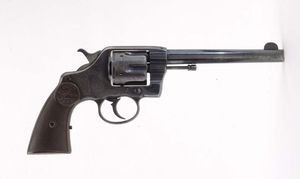
So let's pick apart the situation. If you're an officer watching the horror unfold, you're likely armed with a .38 Colt M1892 revolver just like the one you see here:


Despite (or perhaps in spite) of the fact that it's a cool looking modern gun, it's also chambered in one of the most anemic and underpowered cartridges ever; the .38 Long Colt cartridge. The bullet in question leaves the muzzle traveling at 770 feet per second, measures .35" at its widest point, and weighs in at 150 grains. If you're not a gun dork, those specificiations are probably meaningless.

So let's put this in perspective. When the Army called in its engineers they responded with the 1911A1; an even cooler even more modern looking pistol design which was chambered in the new .45ACP caliber. The bullet leaves the muzzle at between 850-900 feet per second (a full 100 feet faster and just shy of the speed of sound) weighs in at 230 grains (a full 80 grains heavier or 65% heavier) and measuring .45" at its widest point (for a gain of .1" in width or more than a 10% increase). In other words, the Army went from being armed with pistols that shot out a pea to pistols that--for all intents and purposes--drove a metaphorical bowling ball towards the enemy at near supersonic speeds.

The new gun was named the 1911A1 pistol and looked a little something like this:

Designed by John Moses Browning the 1911A1 was the standard sidearm of the American military forces between 1905 and 1989, and still remains the top choice of elite tactical units the world over (the FBI SWAT team still arms its members with 1911 pistols). What's more, for the almost century long career of the 1911A1 pistol, the American forces had the biggest most powerful pistol of any other nation. Aside from bigger bullets, the 1911 design allowed officers to reload their guns more quickly than ever before, carry an extra 2 rounds than before, and (perhaps most importantly) look way cooler than their allies or enemies.

What happened in 1989? America's allies in NATO grew tired of not being able to have compatible ammunition with them, because American guns were way bigger. So, in 1989 the United States officially retired the M1911A1 pistol in favor of the 9mm Beretta M9. Which incidentally, decreased the bullet size to the same .35" that had prompted the adoption of the .45. Now, a few years after switching to the 9mm (.35 caliber), many elite units of the Marines are dusting off their old stores of 1911's, mostly because they're tired of getting overrun and killed by poorly armed enemy combatants (sound familiar?).


So, what's the lesson to be learned from all this? There are probably a few. First, never ever ever underestimate your enemy. Second, when in doubt grab the biggest gun you can. Third, American philosophy towards armament had a historical bigger is better philosophy.

Excelsior!

Epilogue

Watch 1998's film: Ronin starring Robert De Niro, and you'll notice he's carrying a 1911. In the opening moments of the film his character gets into a discussion with a weapons expert/dealer about what his choice of sidearm is. His answer? After being told the virtues of the most modern 9mm pistol; "[sic]a 1911, because it works."


Friday, January 7, 2011

Fun Fact Friday

Here at the Winter Wonderland Workshop at Pheasant Run in St. Charles, IL there are 158 students which makes us the largest stage combat workshop in North America!

Definitely a fun fact!

Greg

Thursday, January 6, 2011

Think Tank Thursday: Historical Accuracy or Rose Colored Fallacy

There are plenty of folks in the stage combat world who strive towards historical accuracy in movement. A majority of the debate that is kicked up revolves around the surviving fight manuals from different time periods.

A few important problems arise from trying to read too much into historical manuals.

One, the progression of art can be seen as the manuals move through history. The Codex Wallerstein (which is on the Fight Jam site!) is one of the oldest fight manuals and all of the drawings are flat. Depth and Perspective had not been developed yet. Despite this, many claim that the Codex advocated parrying with the flat of the.blade. The images do seem to suggest as much but it is not clear whether it Is intentional or a consequence of the artistic abilities of the time. By tue time you get to Capo Fero artistic techniques developed to show great detail and edge to edge parries that we use today can be seen.

This leads to number two: ideal vs Practical
You can take martial arts training in present day as a suitable example. No matter how much someone trains in a particular discipline the ideal situations practice in the dojo rarely arise and fights tend to quickly degrade into furious fist and foot flying.
So, the manuals may demonstrate a prevailing theory of the time but that does not necessarily mean it represents the historical way the weapon was used.

This in turn leads to three: Many Different Theories

The manuals we use to base historical accuracy are the surviving manuals. While it wasn't as easy to make your own manual in the past there were certainly more than one or two per century or country.
Self defense was just as much a business then as it is now. Sure, they actually encountered violence more but that is all the kore reason for a surplus of self defense schools. Old manuals survive for a variety of reasons. Some are lucky, some had extremely motivated and charismatic authors to ensure longevity, and some were just plain good. Many, many more disappear for the exact opposite reasons.
So are we really looking at history or are we looking at what was lucky enough to survive history?

This doesn't mean manuals aren't valuable resources. They can provide great inspiration, and even instruction at times. What they do not provide is anything definitive and if we aren't sure you van bet the audience won't understand or know the difference.

If interested in forming your own opinion check out the historical manuals we have on our site (www.fightjamchicago.com).

Greg

"And That's Real"

Tuesday, January 4, 2011

Text Tuesday: Master Of The Blade

By Richard Ryan

This book demonstrates more how Ryan is a "master" of self promotion than anything else. Master Of The Blade reads like a dry cell phone manual, highlighting old techniques as if they are new and improved and touting new but useless tools.

Where it differs from a manual is in how it spends enormous amounts of ink bashing every other method only to place itself as the one true way to fight with a knife (in some ways fight at all). Some of the cover praise talks about a scientific approach to self defense. If coming up with your own fancy names for things (Dynamic Combat System) qualifies as scientific then I am a the rocket scientist of Simulated Hitting Involved with Theatricality (S.H.I.T.).

Before it seems like I have a one way ticket on the negativity express, I do applaud his gusto in developing what works for him. I also think the book can provide hope, because if he can be "successful" then there Is no reason why anyone else cant be to. My biggest qualm is the idea bashing mentioned above.

If you hate martial arts and are drawn to type Omega A personalities then this is your book.

If you are looking for an honest look at knife fighting and violence, go read stuff by Marc "animal" Macyoung.

Greg

"And That's Real"

Monday, January 3, 2011

Martial Arts/Movie Monday: Kung-Faux

One of my quibbles about movies and TV is when a non-existent fighting art is presented.
Not that there is anything wrong with indulging in a little fantasy or being creative, especially if the movie is set in a completely fictional universe (the planet Pandora in "Avatar" for example). However, there is a big difference when the fantasy has some grounding in plausible reality, and when it seems to have been seemingly created on a whim with no thought or research. In terms of onscreen fighting, all the best fictional fighting styles feel like they were devised by someone with knowledge of how combat functions in the real world. In my opinion, a good example of creative talent applying themselves to the fullest would be Peter Jackson's "Lord of the Rings" movies. No where in history have there ever been elves, orcs, goblins or Uruk-Hai, but working from Tolkien's text and in cooperation with the costume and props staff, the LOTR crafted believable and distinctive fighting styles for each of the races of Middle Earth, all with (apparent) grounding in actual medieval fighting, but not overly derivative of one particular culture.

However, then there are those other movies and TV shows that leave you wondering, what they were thinking? Here's a few of my least favorites:

Anbo-jutsu from "Star Trek: The Next Generation."
In this circa 1989 episode, Commander Will Riker attempts to settle his personal issues with his father by engaging in a one-on-one match of "anbo-jutsu" (translation: "blind-technique") that more closely resembles a bad episode of 'American Gladiators' (or Nickelodeon's 'Double Dare') than a lethal form of combat. (BTW, their Japanese pronunciations is God-awful)
http://www.youtube.com/watch?v=E6DvMKmhenQ

Kosho from "The Prisoner"
One of the best, mind-bending science fiction/espionage dramas is the late-60s show "The Prisoner" starring Patrick McGoohan. If you've never seen it, it's brilliant. I highly recommend renting it on DVD. HOWEVER, for some reason McGoohan himself (as co-creator and co-writer) came up with a bizarre tournament martial art for the characters to periodically engage in that involved trampolines, water and some silly outfits.
http://www.youtube.com/watch?v=NTqAfJYWe58

"Last Hero in China" (1993)
Okay, even the great ones can make missteps. Jet Li made a name for himself in Hong Kong in the 90s with a series a films about legendary (and real-life) martial artist Wong Fei-Hong. In this sequel, Wong encounters a cult that battles using a giant centipede puppet (no joke). In a fit of inspiration, Wong invents a new fighting style based on the ancient enemy of the centipede - the chicken(?!)
http://www.youtube.com/watch?v=2RhZiegns9o

"Warriors of Virtue" (1997)
It's not so much the fighting style in this movie as the fighters that I take issue with this time around. This forgotten feature is an odd Wizard-of-Oz-ish fantasy about a boy who travels to a magical realm where he teams up with some kung-fu fighting warriors against an evil overlord (blah, blah, blah). However, the writers decided that the most fearsome creatures they could come up with for our protagonists was a race of anthropomorphized giant bunny rabbits.
http://www.youtube.com/watch?v=LzofuNqUb4c

"Gymkata" (1985)
I included this in an earlier posting but it definitely deserves mention today. An awful, awful, stupid, ridiculous movie in which then-Olympic star Kurt Thomas beats down bad guys with a martial art based on . . . gymnastics. The pommel horse fight is classic badness.
http://www.youtube.com/watch?v=-gTkUcXGF_Q

Sunday, January 2, 2011

Shoot 'em up Sunday; Two for flinching. . . .

Alright, your flinching might not look like existential horror, but. . .

(Before proceeding, please follow these safety rules. First, choose a good safe place to practice, where everyone knows you're practicing. Second, point all guns in a safe direction. Third, when in doubt STOP and find an expert to help you out. Use of the following information is done at your own risk and you accept all personal liability for it.)

Remember that game, when you were a kid where someone (generally an older sibling) would feign an attack, and if you flinched, you'd get hit twice? If you're older now, I hope that you've either (a) watched them lose their hair and/or grow fat or (b) made much more money then they have. . .

However. . .There's a lesson to be learned in all of this. . . Especially when it comes to playing with guns, for stage and screen.

Let's think about the flinch response. The whole point of the two for flinching game was for the person not to hit you. Even so, you flinched. Why? Because when you're caught by surprise or you think something bad is about to happen you tense and cover--evolution has granted us the gift of survival instincts. Eventually, even if you got used to the notion that you wouldn't get hit, you'd still tense and flinch.

Right about now, you're asking yourself what all of this has to do with guns. . . Plenty!

Let's face it, guns are loud and--particularly if you don't have much experience with them--they're kind of scary. All of this amounts to one thing, many people will flinch and look nervous when they're about to pull a trigger. Natural? Yes. Helpful? Hell no. If you happen to actually be shooting a gun, flinching is the enemy of accuracy.

Standing on stage, or--worse yet--with a camera close up flinching is also the enemy of looking like a bad ass. Whether you're watching John Wayne or Daniel Craig, they neither blink nor do they bat an eyelash while pulling the trigger. That says something about their characters, doesn't it?

On the other hand, you might be playing the part of a terrified person pulling the trigger out of desperation. . . in which case you might just want to ignore this next bit. . .

Rehearsal and more rehearsal. . .goes a long way toward getting rid of your flinch. There are a couple drills that are helpful.

First off, try out the "ball and dummy" drill. Have someone else (like your friendly stage manager / theater armorer) load your gun for you. Choose a SAFE location to practice firing. The important part is for that other person to substitute dummy rounds at random, or not load the gun without telling you and than have you pull the trigger. Chances are, the first time you pull the trigger on an unloaded gun; you'll be flinching. Equally likely, will be the embarrassed look on your face when you realize you're reacting to nothing. However, you're well on your way to curing your flinch. . . Keep doing this drill, until you train your instinctual flinch out of your muscle memory.

Second, dry firing. This may or may not be an option for you, but if it is; take advantage of it! Taking the unloaded gun, pulling the trigger, and handling it will help you out a ton. Again, choose a SAFE PLACE to do all of this. However, the more accustomed you become to the feeling of the gun in your hand and its mechanics, the less likely you'll be to let your fear/anxiety inform the way you handle the gun.

Third, be your character. . .At the end of the day, your character will tell you what kind of gunfighter you are. . . Therein lies the secret to it all. . . .If that doesn't work, check out numbers one and two above.

Excelsior!